Ours is an undisciplined age. The old disciplines are breaking down…above all, the discipline of divine graces is derided as legalism or is entirely unknown to a generation that is largely illiterate in the Scriptures. We need the rugged strength of Christian character that can come only from discipline. 1
V. Raymond Edman
Thousands of books and articles have attempted to define spiritual formation. While many lists of spiritual disciplines share common elements, scholars often differ on which disciplines are most essential. For the purposes of this blog, both now and in the future, we will focus on twelve spiritual disciplines: Bible study, prayer, fasting, ministry, evangelism, worship, stewardship, confession, meditation, fellowship, soul care, and journaling.
Together, these disciplines provide a comprehensive and holistic approach to spiritual growth and development. Jane Thayer explains, “Through concrete experience, spiritual knowledge is grasped by the personal experience of relating to God; through abstract conceptualization, it is grasped by abstract symbols of language in and hearing both the Scriptures and testimonies of others experienced. Through reflective observation, spiritual knowledge is transformed into learning by critical reflection; through active experimentation, it is transformed into learning by praxis.”2 In simpler terms, spiritual formation involves every dimension of learning and experience. It engages the mind, heart, and actions of the believer so that growth is intentional and complete, leaving nothing to chance.
These spiritual disciplines are firmly grounded in Scripture. Throughout the Bible, we find both examples and commands concerning these practices. The heroes of the faith embraced them, while many of the Bible’s anti-heroes neglected them. Jesus Himself modeled these disciplines perfectly, and the Apostle Paul provided much of the theological framework for understanding them.
The disciplines also address the deeply personal aspects of our lives. Many focus inwardly, challenging us at the core of who we are. They lead us into places we often hesitate to expose, confronting us with our true selves in light of God’s holiness. In these moments, we encounter the Father. We see His glory, experience His presence, and receive His hope, mercy, and comfort.
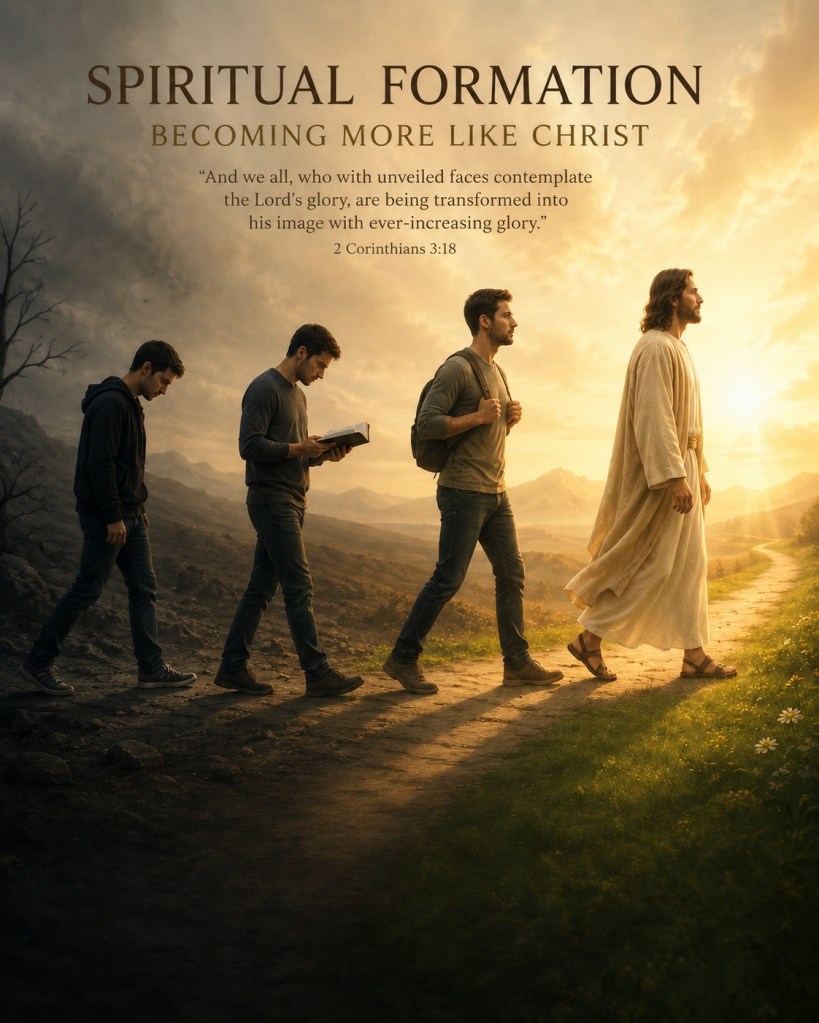
At the same time, these disciplines shape the way we relate to others. They teach us to see people as God sees them. We learn to love our enemies, extend compassion to the broken, and offer mercy to those who seem forgotten or hopeless. Spiritual formation destroys comfortable boundaries and calls us beyond ourselves. It leads us to places we would not naturally choose and asks us to do what may feel uncomfortable or inconvenient. These disciplines call for surrender and remind us that greatness in God’s kingdom is found in humility and service. They compel us to go, tell, and baptize. Ultimately, these practices lead believers toward holiness and godliness. Dallas Willard captures this truth well: “The most important thing in your life is not what you do; it’s who you become.”3
“So, the Spiritual Disciplines are those personal and interpersonal activities given by God in the Bible as the sufficient means believers in Jesus Christ are to use in the Spirit-filled, gospel-driven pursuit of godliness, that is, closeness to Christ and conformity to Christ.”4
Endnotes:
1 Donald S. Whitney, Spiritual Disciplines for the Christian Life (Colorado Springs, CO: Tyndale House Publishers, 1991), 19, Kindle Edition.
2 Jane Thayer, “Constructing a Spiritual Measure Based on Learning Theory: The Christian Spiritual Participation Profile,” Journal of Psychology and Christianity, vol 1 (March 2004),197.
3 John Ortberg, Soul Keeping (Grand Rapids, MI: Zondervan, 2014), 32.
4 Whitney, 31.


Leave a Reply